SuperRare’s Liquid Editions Turn Markets Into Art
SuperRare’s Liquid Editions transform ERC-20 tokens into living artworks shaped by trading activity, introducing a groundbreaking new model for NFTs and crypto art.
SuperRare has never been particularly interested in doing things the easy way. From its earliest days, the platform positioned itself not as a mass marketplace but as a curated environment where crypto art could mature into something closer to a cultural movement than a speculative trend. That long-term orientation matters when trying to understand why its newest experiment, Liquid Editions, feels less like a gimmick and more like a genuine inflection point.
On March 5, 2026, after a brief delay that quietly reminded everyone this was real infrastructure rather than a marketing stunt, SuperRare launched Liquid Editions to the public. What emerged was not another NFT drop in the conventional sense but a new generative art protocol where fungible tokens themselves become the artwork. The result is something that challenges nearly every assumption people still carry about what an NFT is supposed to be.
Rethinking the NFT Format
Liquid Editions abandon the familiar ERC-721 NFT format entirely. There are no static images, no numbered 1/1 collectibles, and no frozen metadata waiting to be admired in a wallet gallery. Instead, each edition is an ERC-20 token with a fixed supply of one million units, and the artwork is rendered live, directly from the token’s on-chain market behavior.
Trades, transfers, liquidity movements, balance changes, and price spreads are not peripheral data points. They become the raw material of the art itself. This is what SuperRare and participating artists describe as “market as medium.”
The market is no longer just the place where art changes hands after it is created. The market is where the art actually happens. Every act of participation alters the visual state of the piece, sometimes subtly and sometimes in ways that are impossible to ignore.
Two Surfaces: Visual and Market
Each Liquid Edition operates across two integrated layers.
The first is the visual surface, which is the dynamic artwork rendered by a smart contract. The image updates whenever relevant transactions occur, meaning the artwork never fully settles into a final form. It continues to evolve as long as the token continues to trade.
The second is the market surface, which includes the token’s liquidity pools, holder distribution, swaps, and price discovery mechanisms. These elements form the real-time data inputs that drive the generative rendering process.
What makes Liquid Editions particularly interesting is that these two surfaces are inseparable. You cannot observe the art without observing the market state that created it, and you cannot interact with the market without contributing to the art’s evolution. In a sense, the artwork becomes a living record of collective behavior.
How Liquid Editions Work Under the Hood
Structurally, the protocol is designed to balance liquidity with artistic control.
Each Liquid Edition launches with a fixed supply of 1,000,000 tokens, providing fractional access to the artwork while maintaining predictable scarcity. Trading begins immediately through SuperRare’s integrated marketplace infrastructure, typically using bonding curve or Doppler-style mechanisms that provide instant liquidity before transitioning to more traditional liquidity pools.
Swap fees are set at 5% and split between the artist and the platform, creating a model where artists continue benefiting from market participation rather than relying solely on an initial sale.
SuperRare’s ecosystem token, $RARE, plays an important role as well. RARE functions as a reserve currency and liquidity base for Liquid Editions, while new deployments include on-chain RARE burns that introduce deflationary pressure and additional utility for the token.
Another optional feature called Lenses introduces a fascinating creative layer. Lenses are ERC-721 NFTs that provide alternative visual interpretations of the same underlying market data. The core artwork remains unchanged, but collectors can experience the same market-driven piece through different aesthetic perspectives.
The First Liquid Edition: Value Discovery
To demonstrate the concept, SuperRare launched the inaugural Liquid Edition alongside the protocol itself.
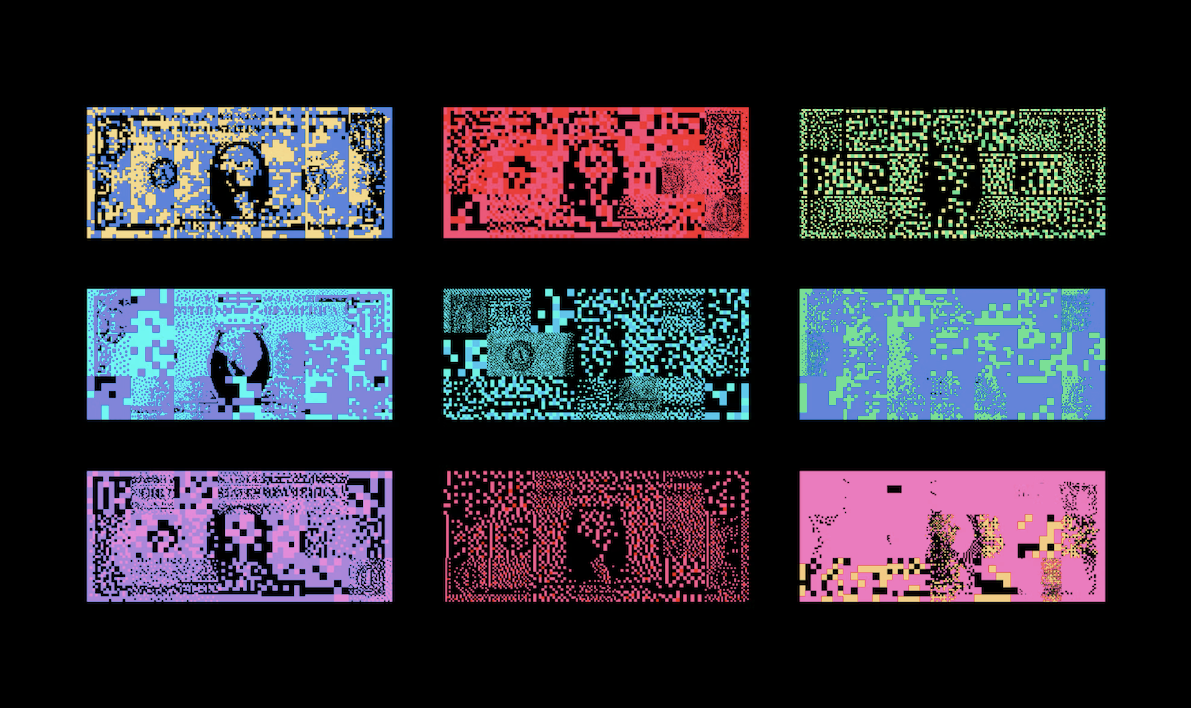
The piece, titled Value Discovery, was created by the artist Ripe. At first glance it appears as a distorted, glitching US dollar bill. But beneath that aesthetic surface lies a surprisingly sophisticated market-driven engine.
The artwork tracks two Uniswap v4 liquidity pools for the same token, each operating with different fee tiers. When those pools diverge in price, the difference creates what the artist calls “error.” That error is then translated visually using classic dithering techniques such as Floyd-Steinberg and Atkinson diffusion, spreading the discrepancy across the artwork in shifting pixel patterns.
When the pools align perfectly and the price spread disappears, the artwork quiets and may even fade into stillness. But when disagreement widens, the image erupts into a vibrant battle of pixels across the dollar bill grid, where color intensity reflects the magnitude of the market divergence.
Occasionally, arbitrage closes the spread completely. When that happens, the system captures a rare visual frame, minting it as one of a maximum of twelve NFTs tied to that moment of equilibrium. Even within a fungible token artwork, scarcity emerges organically through market behavior.
SuperRare’s Track Record in Crypto Art
The credibility of Liquid Editions is tied closely to SuperRare’s history.
Founded in 2018, the platform quickly established itself as one of the earliest dedicated marketplaces for on-chain digital art. While many NFT platforms focused on high-volume minting, SuperRare emphasized curation and artistic credibility, attracting artists who would later become defining figures of the crypto art movement.
During the explosive NFT cycle of 2020 and 2021, SuperRare hosted influential works from artists like XCOPY, Pak, and Hackatao. These sales helped position the platform as a more gallery-like environment compared to the open minting platforms that dominated the broader NFT economy.
The platform continued evolving after the peak hype cycle. In 2021, SuperRare introduced the $RARE governance token, gradually decentralizing aspects of the ecosystem and enabling community-led gallery spaces. This transition from marketplace to decentralized art network reinforced its reputation as a long-term infrastructure builder rather than a short-term trend participant.
Liquid Editions represent the next step in that progression, pushing experimentation beyond marketplaces and into the very mechanics of ownership and markets themselves.
Addressing the NFT Liquidity Problem
One of the persistent challenges in the NFT ecosystem has always been liquidity.
High-value 1/1 artworks can carry cultural significance while remaining economically stagnant simply because finding a buyer at the right moment is difficult. Price discovery often stalls, and collectors sometimes hold assets for years without meaningful market activity.
Liquid Editions approach this problem from a completely different angle. By making the artwork fungible and continuously tradable, they allow price discovery to happen organically while preserving the artistic integrity of the piece.
Collectors no longer need to purchase the entire artwork to participate. They can enter or exit positions freely, trading fractions of the piece whenever they choose. At the same time, every trade contributes to the artwork’s evolving visual state, ensuring that liquidity and artistic participation remain tightly connected.
Collectors Become Participants
The shift from static NFTs to dynamic tokenized artworks changes the role of collectors in subtle but important ways.
Ownership is no longer purely custodial. Instead, collectors become participants whose actions actively influence the artwork in real time. A large buy order might shift the visual composition dramatically, while arbitrage events between liquidity pools might trigger rare moments that are permanently recorded as NFTs.
Even periods of quiet market activity become part of the piece. When trading slows, the artwork may stabilize visually, creating a sense of calm before the next wave of participation begins.
In this way, Liquid Editions turn the artwork into a living system rather than a finished object. It records not just ownership but behavior.
Early Market Reaction
Within the first twenty-four hours of launch, Value Discovery began trading actively on SuperRare, with early collectors accumulating positions and exploring how their trades affected the visual output. Top holders quickly emerged, some controlling several thousand tokens as the market began to form around the piece.
On social media platforms like X, reactions from the crypto art community were overwhelmingly positive. Many collectors described the launch as one of the most interesting experiments in on-chain art in years, praising the way the system blends liquidity, generative design, and market dynamics into a single artistic framework.
While it is still early, the initial response suggests that collectors are intrigued not just by the concept but by the interactive experience it creates.
Why Liquid Editions Matter for the Future of NFTs
The NFT ecosystem evolves quickly, and not every innovation reshapes the landscape. But Liquid Editions introduce several ideas that feel particularly significant.
They merge fungible liquidity with generative art, two areas that historically operated in separate corners of the blockchain world. They also treat market behavior as an aesthetic input rather than a purely financial variable. Most importantly, they give artists a new creative toolkit that transforms economic systems into artistic material.
Markets express human emotion in real time. They reflect speculation, excitement, disagreement, and discovery. Liquid Editions translate those emotional signals into visual form.
A New Chapter in Crypto Art
Crypto art has always advanced through experimentation rather than consensus. The most interesting ideas tend to emerge when artists and technologists push beyond the familiar boundaries of NFTs.
Liquid Editions embrace that experimental spirit completely. The artwork evolves as people trade. Collectors become collaborators in the creative process. And price itself becomes part of the image.
It is an unusual idea, but the history of crypto art suggests that unusual ideas are often the ones that define the next chapter.