A Fully On-Chain NFT From 2018 That Nobody's Heard Of
Cryptodate is one of Ethereum’s oldest NFT projects: one fully on-chain NFT per calendar date, launched in 2018 and surviving pivots, hype cycles, and time.
Crypto projects evolve. Sometimes they pivot. Sometimes they die. And sometimes they come full circle. This is the story of Cryptodate—an NFT project deployed to Ethereum mainnet in June 2018, making it older than 99% of the NFTs in existence.
2017: The World Discovers Digital Cats
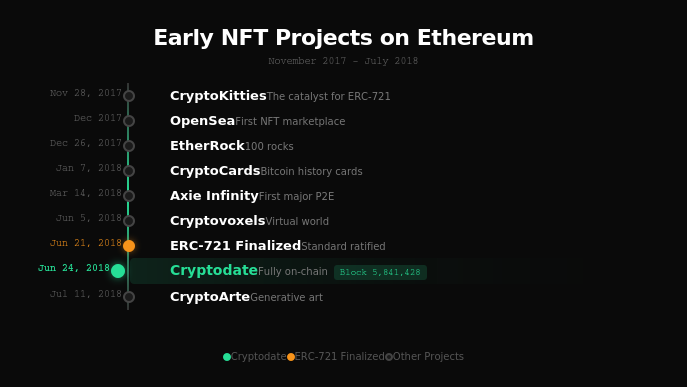
If you were paying attention to crypto in late 2017, you remember the moment CryptoKitties launched and promptly clogged the entire Ethereum network. Gas prices spiked. Transactions backed up for hours. And suddenly this obscure concept of "non-fungible tokens" had a use case that people could wrap their heads around: unique collectibles. The ERC-721 standard was still being finalized, but it was clear that digital scarcity was a thing. Provable ownership of unique assets on a public blockchain was real. And where there are collectibles, there's trade.
Building a Marketplace
A small team saw what was happening and realized people were going to want to trade these things, and they'd need a place to do it. So they started building an NFT marketplace. They bought the domain Etherbay—yes, Etherbay—because why not. The concept was straightforward: create a secondary marketplace where people could list, auction and buy NFTs. This was before OpenSea had any real traction, before anyone knew what the market would look like or how the tech would work. They were figuring it out as they went.
They Needed Their Own NFT
Here's the thing about building a marketplace: you can't develop listing flows, transfer mechanics, and auction logic without actual assets to test against. The team didn't want to rely on CryptoKitties or someone else's NFTs. They needed something they controlled, something simple enough that they could focus on the marketplace mechanics without getting distracted by complex game logic or breeding algorithms. So they started thinking about what kind of NFT they could create that would serve as a test case but also stand on its own as a legitimate project.
The idea they landed on was Cryptodate. The concept is simple: every calendar date is a token ID. July 4, 1776 becomes token ID 17760704. The Bitcoin genesis block on January 3, 2009 becomes 20090103. Your birthday, your anniversary, the day you met someone—each one maps to an eight-digit number, and each one can only ever have one owner. One date, one NFT, forever. That's the whole thing.
The team liked this idea for reasons beyond just needing a test NFT. Most NFT projects rely on off-chain data—the token ID is on Ethereum, but the actual content (the image, the metadata) lives on some server somewhere. If that server goes down because someone didn't pay the bill, the NFT points to nothing. And IPFS isn't exactly a guarantee. Collectors can easily end up owning a receipt for something that no longer exists.
The Cryptodate team never loved that approach. If you're going to put something on the blockchain, put it on the blockchain. Cryptodate solved this elegantly: the token ID is the date. There's no image to host, no metadata server to maintain, no dependency on external infrastructure. The date is the NFT. Fully on-chain, completely self-contained, and permanent for as long as Ethereum exists.
The Cryptodate smart contract was deployed on June 24, 2018—block 5,841,428. This was nine days after ERC-721 was officially finalized.

Etherbay Dies, Cryptodate Lives
And then the marketplace project fell apart. It turns out eBay's lawyers don't have a sense of humor about domain names. A cease and desist letter arrived, and suddenly the clever branding was a liability. The team could have rebranded, but by that point the competitive landscape was shifting. OpenSea was gaining traction and had more resources. Between the legal pressure and the market dynamics, they made the call to shut Etherbay down. The timing wasn't right, the name was legally radioactive, and they had other things going on.
But Cryptodate was already deployed. The contract sat there on mainnet, quietly existing. A simple website went up where anyone could mint for a small fee, and then the team moved on with their lives. They didn't market it, didn't build a community around it, didn't do any of the things you're supposed to do with an NFT project. It just... existed.
2022: The DeFi Detour
Fast forward four years. DeFi summer had come and gone, and the entire landscape looked different. Layer 2s were proliferating—Arbitrum, Optimism, Fantom, Moonriver and dozens of others promising cheap transactions and Ethereum security. The Cryptodate team had bandwidth to experiment again, having spent the intervening years on other projects.
Then they had what seemed like a clever idea: yield-bearing NFTs. The concept was to tie an NFT to an ERC-20 token that generated interest, combining the collectibility of NFTs with the passive income mechanics that DeFi users loved. They built an ERC20 Cryptodate token (CDT) that was directly tied to the NFT. They extended the Cryptodate ERC721 contract to support the concept of yield-bearing NFTs such that holders would earn CDT as interest. A percentage of the ETH from each NFT sale went directly into the CDT liquidity pool, which made the CDT valuable without artifice. The contracts contain some technically solid ideas and can still be viewed on Github for those curious about the approach.
The team deployed the "new" Cryptodate to multiple Layer 2s. They embraced where NFTs had gone in the intervening years—artwork, generative collections, the whole playbook. They worked with artists to create SVG collections for each date, including a "Cryptopupper" series with genetics.
The pivot gained some traction, but the project never really took off. The yield-bearing NFT concept was perhaps too complicated, or the timing was wrong, or the marketing just didn't land. That's life in crypto—most things don't work, and you learn what you can from the experience.
2026: Back to Basics
Here in 2026, the landscape has shifted again. Layer 2s are consolidating as Ethereum makes progress on scalability. The NFT market has contracted hard—most projects from the 2021-2022 boom are dead, their Discord servers silent, their OpenSea pages gathering dust. The projects that survived tend to share certain characteristics: conceptual clarity, genuine scarcity, and verifiable provenance. Cryptodate, it turns out, has all three.
So the team made a decision: strip it back down. They've removed the yield-bearing NFT mechanics, which were never deployed to Ethereum mainnet anyway. They've sunset the Layer 2 deployments. They've dropped the CDT token. What's left is the original value proposition from 2018: own a date. One NFT per date, fully on-chain, from one of the oldest NFT contracts on Ethereum.
With that in mind, the team has updated the frontend dapp. The rebuild is a clean break: Next.js 14, TypeScript, Tailwind CSS, and shadcn/ui for the component library. For wallet connectivity and contract interaction, they're using wagmi and viem, which have become the de facto standard for Ethereum frontend work, replacing the aging ethers.js/web3.js patterns.
The architecture is deliberately minimal. No multi-chain support. No token swaps. No staking mechanics. Just: connect wallet, pick a date, check availability, mint. The contract itself hasn't changed—it's the same code sitting at the same address since block 5,841,428. Only the frontend needed modernizing.

For collectors who care about historical NFTs—the kind who own early CryptoKitties or Curio Cards or have opinions about which projects deserve to be on Leonidas's timeline—Cryptodate may be worth a look. The project's been on-chain for eight years, quietly waiting to be rediscovered.